NightClub Simulator
- 4.7
- Rating
- 1.00M
- Installs
- Free
- Price

 Analysis by App-foxy
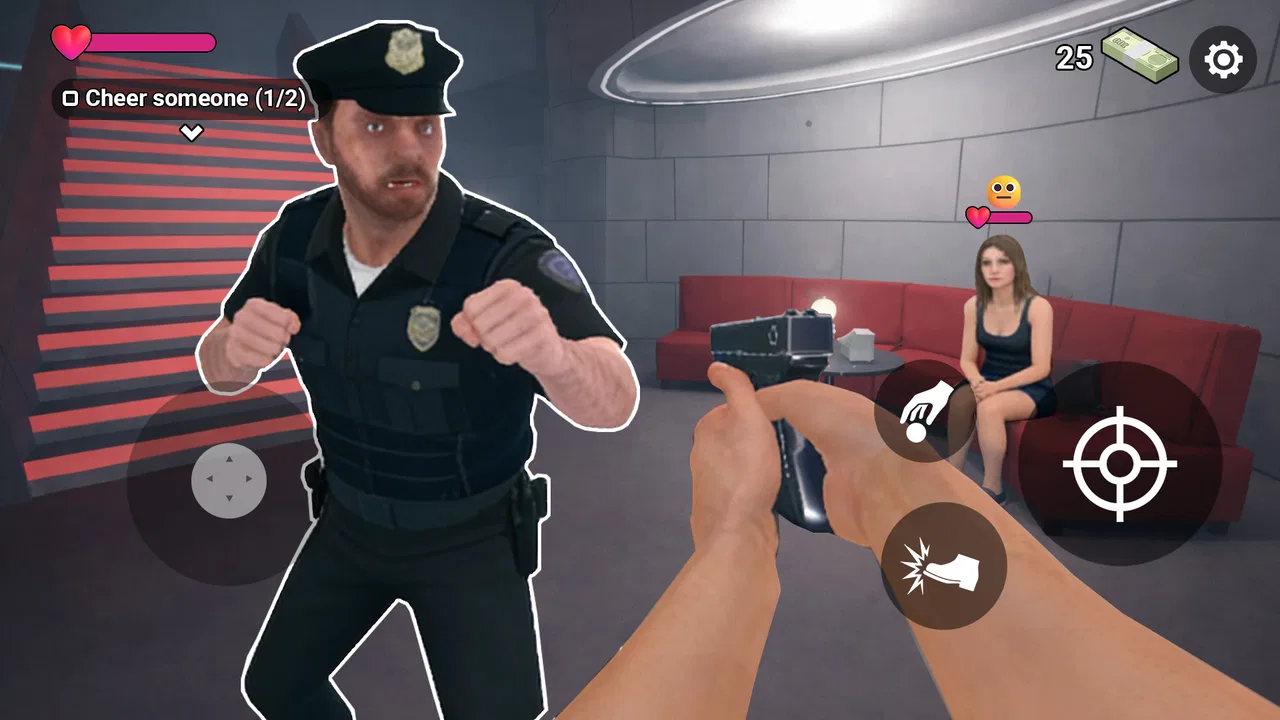
I went into NightClub Simulator expecting a light management game, but its identity is closer to a playable night out with a rougher, more chaotic edge. It combines dancing, fights, and a story-driven setup rather than focusing only on arranging furniture or watching numbers rise. That mixture gives it a distinctive mood, although it also means the game will not suit everyone looking for a calm simulation experience.
Developed by Ant Hill Games, this free simulation game is aimed at players who enjoy nightlife themes but still want direct action. I found the appeal strongest when I treated each session as a short episode: enter with a simple objective, deal with whatever the club throws at me, and see how the story and atmosphere develop. The result is more immediate than a traditional business simulator, but less predictable than a straightforward dance game.
How the club builds momentum from the first session
I find the opening works best when I treat it as a quick visit rather than a checklist: I pay attention to the immediate situation, then let the mix of dancing, story, and conflict set the pace. That makes it easier to notice what the game is asking of me before I settle into a routine. From there, the next question is how to make room for it on a shared device without blurring anyone’s boundaries.
You May Also Like

 Blood Strike: 2.5 Anniversary
Blood Strike’s Loadouts Turn Every Drop Into a Tactical Gamble
A close look at Blood Strike’s custom loadouts: how fast access to signature weapons reshapes its battle royale rhythm, rewards preparation, and narrows the gap between fights.

 Pandora - Music & Podcasts
Pandora’s Music Is Easy to Start, but Harder to Recover
Pandora’s strength is its low-effort path from a seed to a station. Its weak spot is how much confidence it asks you to place in connection, setup, and quiet recovery.

 8 Ball Pool
 Is Built on Rivalries, Rematches, and Routine
A close look at the rivalries, rematches, shared routines, and unanswered safety questions that turn a quick pool match into a persistent mobile community.

 Samsung Music
’s Quiet Strength Is Playing What You Already Own
Its reach comes less from spectacle than from dependable access to a personal library. That simplicity is both the app’s strongest retention engine and its ceiling.

 AccuWeather: Weather Radar
AccuWeather Review: A Quick, Clear Forecast for Everyday Decisions
For everyday plans, the best forecast is the one you can understand quickly. AccuWeather makes rain timing, radar, and local conditions easy to act on, with a few trade-offs.

 Hill Climb Racing
Why Hill Climb Racing Still Turns Crashes Into One More Run
A tiny car, a bumpy hill and one more upgrade: Hill Climb Racing keeps resurfacing because its simple chaos makes every near-miss feel personal.
More From Our News Desk



Early goals give the chaos a purpose
The opening experience works because the game does not ask me to understand every part of the club at once. The combination of story, dancing, and confrontations creates an obvious reason to keep moving. Even when the action is messy, I usually know what kind of experience the game wants me to have: step into the nightlife, follow the situation, and react quickly when the mood changes.
That is important for a simulation with an unusual setting. A conventional club-management game might begin with menus, budgets, and long-term planning. Here, the early goals feel more personal and immediate. I am not simply observing a venue from above; I am involved in what happens inside it. This makes the first sessions easier to approach for players who normally avoid spreadsheet-heavy simulations.
The trade-off is that anyone expecting a deep business sandbox may find the early direction too loose. The nightclub is a setting for action and story, not just a system to optimize. I would recommend it to someone who wants a simulation flavor wrapped around an active scenario, rather than to a player seeking a highly detailed economic model.
Progress is felt through context as much as rewards
One of the more interesting design choices is that progress is not only about a visible score or a larger collection of resources. The story gives the club a sense of movement, while the changing balance between dancing and fights keeps the sessions from feeling like identical rounds. I paid more attention when the game made the environment feel like a place where something was unfolding instead of a static backdrop.
This also affects how I judge a successful session. In a typical simulation, progress can be easy to measure: earn money, expand a building, or unlock a better tool. NightClub Simulator is less satisfying if I need constant numerical confirmation. Its stronger moments come from the feeling that I have handled the latest situation and pushed the experience forward.
That approach makes the game approachable, but it can also make progress feel less concrete. Players who need a clear checklist may want to pause and identify the immediate objective before rushing through the action. I found that small habit useful because it prevents the fights and dancing from becoming disconnected mini-events.
The difficulty curve depends on attention, not patience alone
The game’s challenge comes from switching mental gears. Dancing encourages me to stay with the rhythm and atmosphere, while fights demand a more alert response. That contrast gives the nightclub its character, but it can also make the pacing feel uneven if I am in the mood for only one kind of activity.
I would not describe the experience as a gentle background simulator. It asks me to remain engaged, especially when a relaxed scene turns more aggressive. That makes it a better fit for short, focused play than for leaving the game running while doing something else. A useful approach is to play when I have enough attention for the story and action, rather than treating it as a passive time-filler.
The difficulty also benefits from learning the game’s rhythm instead of trying to force every moment. When the club shifts from social energy to conflict, reacting calmly is more useful than tapping or moving without a plan. This is a small but meaningful distinction: the challenge is not simply about speed, but about recognizing what the current scene expects from me.
Where the pacing works and where it drags
The mixture of activities helps prevent the central idea from becoming repetitive too quickly. If the game stayed entirely focused on dancing, the novelty of the setting could wear thin. If every moment were a fight, the nightclub would lose its atmosphere. The alternating tone gives the experience more personality than a single-mode simulation.
Still, the same variety can create friction. Players who want a smooth, steadily escalating management loop may find the shifts distracting. I sometimes preferred the story-led sections because they gave the action a clearer reason to exist, while other moments felt more like interruptions than meaningful decisions.
For everyday play, I think it works best in compact sessions. After a busy day, I can open it for a quick burst of nightlife-themed action without committing to a long campaign. The free entry point helps with that habit, although the Teen content rating is a useful reminder that the fights and overall tone are not designed for young children.
What keeps me returning
The strongest retention tool is curiosity. I want to see what the next situation brings and how the story frames the club’s unstable atmosphere. That is different from the pull of a pure management game, where I might return mainly to improve efficiency. Here, the setting and the possibility of another unexpected turn do more of the work.
There is a downside to that kind of motivation. Once the novelty of the nightclub, dancing, and fights fades, the game needs its progression to remain satisfying on its own. If a player does not connect with the story or the rough nightlife tone, there may be less reason to continue than in a simulator built around deep customization.
I also think the free model deserves a practical look. The game costs nothing to start, while individual in-app purchases are priced at $3.49 each. That does not automatically make the experience unfair, but I would approach purchases as optional conveniences rather than part of the core reason to play. I prefer to learn whether the basic loop holds my attention before spending anything.
That advice is especially relevant here because the game’s value comes from its atmosphere and moment-to-moment blend, not from owning extras. If the central rhythm does not click during the free experience, a purchase is unlikely to solve that problem. On the other hand, players who already enjoy the setting may see optional spending as a way to support a game they are genuinely using.
How it compares with calmer simulation games
Compared with familiar city builders, farming games, or business simulators, this is much less peaceful. Those alternatives usually reward planning over immediate reaction and let me shape progress at my own speed. NightClub Simulator gives me less distance from the action and more emphasis on what is happening inside the venue right now.
It also differs from a pure rhythm game. Dancing is part of the identity, but it does not define the entire experience. The story and fights make the game less focused and more theatrical. That makes it a better alternative for someone who wants nightlife flavor without committing to a single musical mechanic.
Action games may offer more refined combat, while management games may provide clearer long-term control. This title sits between those expectations. Its advantage is the unusual combination; its weakness is that players seeking depth in only one area may find a specialist game more rewarding.
Who should play and who should skip it
I would point this game toward players who like simulation labels but want something active, strange, and story-aware. It is a good match for someone who enjoys switching between a social atmosphere and sudden conflict, especially when a conventional business simulator feels too slow.
I would be more cautious recommending it to players who dislike fights, want a completely relaxing club-management experience, or need highly transparent progression at every step. The Teen rating and confrontational tone matter here. Families looking for a child-friendly simulation should choose something else, and players who want a serious economic sandbox should probably look for a more specialized management game.
It is also not my first choice for long, uninterrupted sessions if I am looking for a carefully layered strategy campaign. The game’s appeal is strongest in bursts, where the unusual setting stays fresh and the change between activities feels energetic rather than tiring.
Practical expectations before downloading
The game is available free of charge and currently sits at a 4.7 average from around 8.3 thousand ratings, with more than one million installs. Those figures suggest that the concept has reached a substantial audience, but they should not replace personal judgment because the blend of simulation, story, and fights is quite specific.
It runs on Android 7.0 or later, and the current version is 1.1.2. In practical terms, I would check the operating system before installing, then give the opening experience enough time to show its intended rhythm. A quick glance may make it seem like a simple nightclub game, while the actual appeal depends on how well the different activities work together for me.
I also would not approach it expecting a quiet idle experience. The game rewards attention, and its most distinctive moments come from responding to a situation rather than merely collecting passive progress. If I only have a few minutes, that can be an advantage; if I want a slow evening of decorating and planning, it may feel like the wrong tool.
My verdict on goals, challenge, and long-term appeal
After spending time with it, I see NightClub Simulator as a characterful hybrid rather than a complete replacement for traditional simulation games. Its early goals are easy to understand, its story provides a reason to continue, and the movement between dancing and fights gives the pacing a personality that most club-management alternatives do not have.
The progression is most convincing when I judge it through changing situations and narrative momentum. It is less convincing when I want a detailed record of exactly how my decisions improve the venue. That distinction is the key to deciding whether the game will last on my device: I return for the atmosphere and unfolding action, not for an elaborate management dashboard.
My final recommendation is positive but targeted. Try it if you want a free, unusual simulation with a nightlife setting, story elements, and direct confrontations. Keep your expectations measured if you want deep economics, child-friendly content, or a perfectly even difficulty curve. For me, the game earns its place through its odd combination of moods, and the best way to enjoy it is to treat each session as a compact night out rather than a conventional business-planning exercise.
Ant Hill Games has chosen a risky premise, but that risk is also the reason the game stands apart. It does not need to beat every simulator or every action game to be worthwhile. It only needs to make its mix of club atmosphere, dancing, conflict, and story feel engaging enough to bring me back, and in the right short-session context, it does. The real strength is its identity, not mechanical perfection.
FAQs for NightClub Simulator
01What is NightClub Simulator about?
NightClub Simulator is a management and simulation game focused on running a nightclub. Players typically take responsibility for organizing the venue, serving guests, managing staff, improving facilities, and keeping the business profitable. The experience combines business decisions with day-to-day club operations, so success depends on balancing customer satisfaction, finances, security, entertainment, and gradual upgrades rather than simply decorating a venue.
02Is NightClub Simulator free to download and play?
NightClub Simulator may be available as a free download, although the exact pricing model can vary depending on the platform and version. Before installing, check the official store listing for information about advertisements, optional in-app purchases, premium content, and any additional requirements. A free download does not always mean that every feature, upgrade, or resource is available without spending money.
03Does NightClub Simulator require an internet connection?
The connection requirements can depend on the version of NightClub Simulator installed on your device. Core simulation features may work offline in some editions, but advertisements, cloud saves, updates, account services, or purchases can require internet access. It is best to launch the game once while connected and review its permissions and settings before relying on it during travel or in areas with limited connectivity.
04Is NightClub Simulator suitable for children?
Parents should check the age rating and content description for the specific NightClub Simulator release before allowing children to play. Although the main gameplay may focus on business management, a nightclub setting can include mature themes, nightlife-related references, advertisements, or optional purchases. The game may also require supervision if younger players can access online services, external links, or transaction features.
05What devices are compatible with NightClub Simulator?
Compatibility depends on the edition of NightClub Simulator and the operating system used. Check the official Google Play or App Store page for the minimum Android or iOS version, supported device types, storage requirements, and developer recommendations. Older phones and tablets may install the game but still experience slower loading, reduced graphics quality, crashes, or limited performance during busy nightclub scenes.
Pros
- Fun nightlife management gameplay with a distinctive simulator concept.
- Easy-to-learn controls make it accessible to casual players.
- Progression gives you reasons to keep improving the club.
- Creates entertaining situations through crowd and staff interactions.
- Good choice for players who enjoy management and simulation games.
Cons
- Some tasks may become repetitive after extended play sessions.
- The nightclub theme may not appeal to every age group or player.
- Progress can feel slow without spending more time on routine tasks.
- Busy scenes can make it harder to track customers and objectives.
- Performance may vary on older devices with limited hardware.

NightClub Simulator
Gallery